
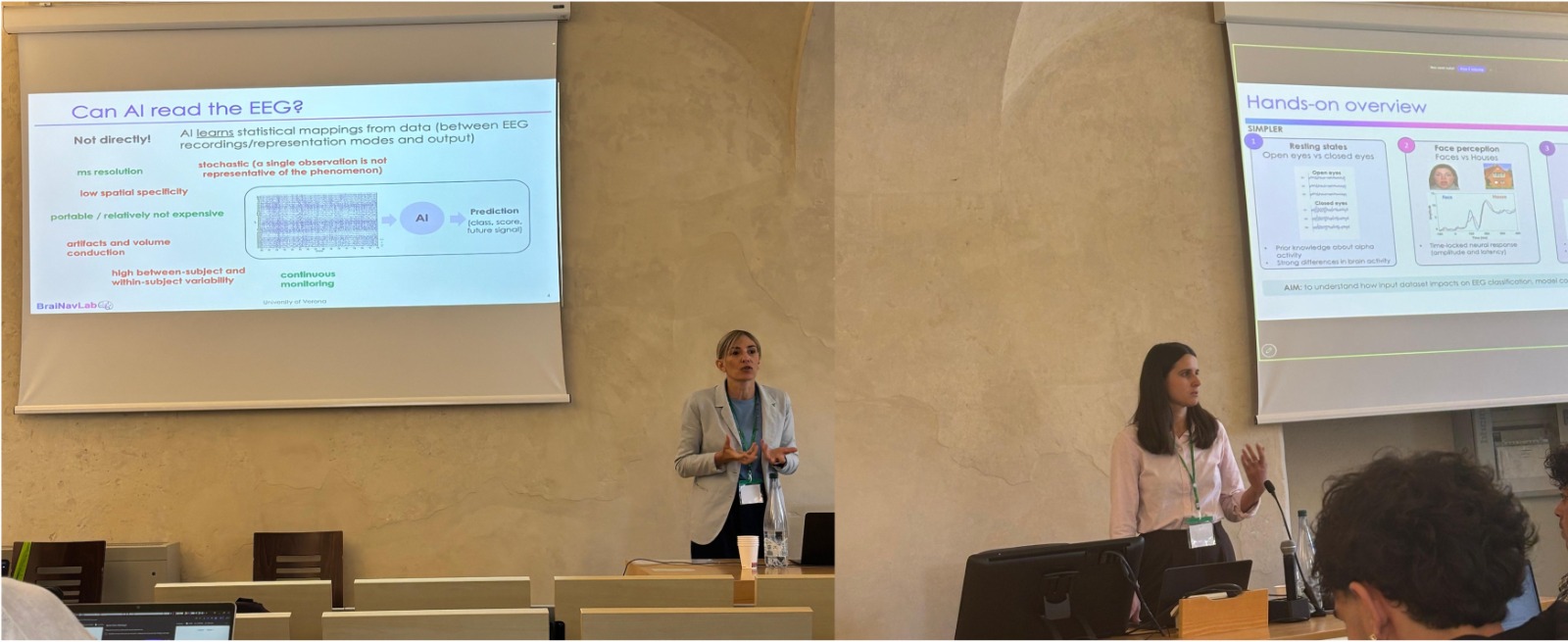
BraiNavLab at Cutting Gardens 2026
We would like to thank the organizers for the kind invitation to contribute to this edition of Cutting Gardens. Silvia Storti presented the talk “Decoding brain signals with AI. What we can and cannot learn from EEG”. The talk discussed how AI can be used to decode EEG signals, but also why good performance is not enough on its own. When a model predicts something from EEG, we still need to ask what information it has used: the brain signal of interest, or another source of variance in the data. The theoretical session was followed by a hands-on lab led by Ilaria Siviero, where participants worked on EEG-AI examples and explored how different signal representations, models, and validation choices affect both performance and interpretation. We are grateful for the discussion and for the interest shown by the Cutting Gardens community. A special thank you to the local organizers from PandA Lab (https://panda.dsnm.univr.it/).

Univr Magazine Highlights Our Lab's Impact on Neuroscience Research
We are thrilled to share that Univr Magazine recently interviewed our team to discuss the laboratory’s growing impact and contributions to the field of neuroscience. Read the entire article to discover our latest insights and future research directions!
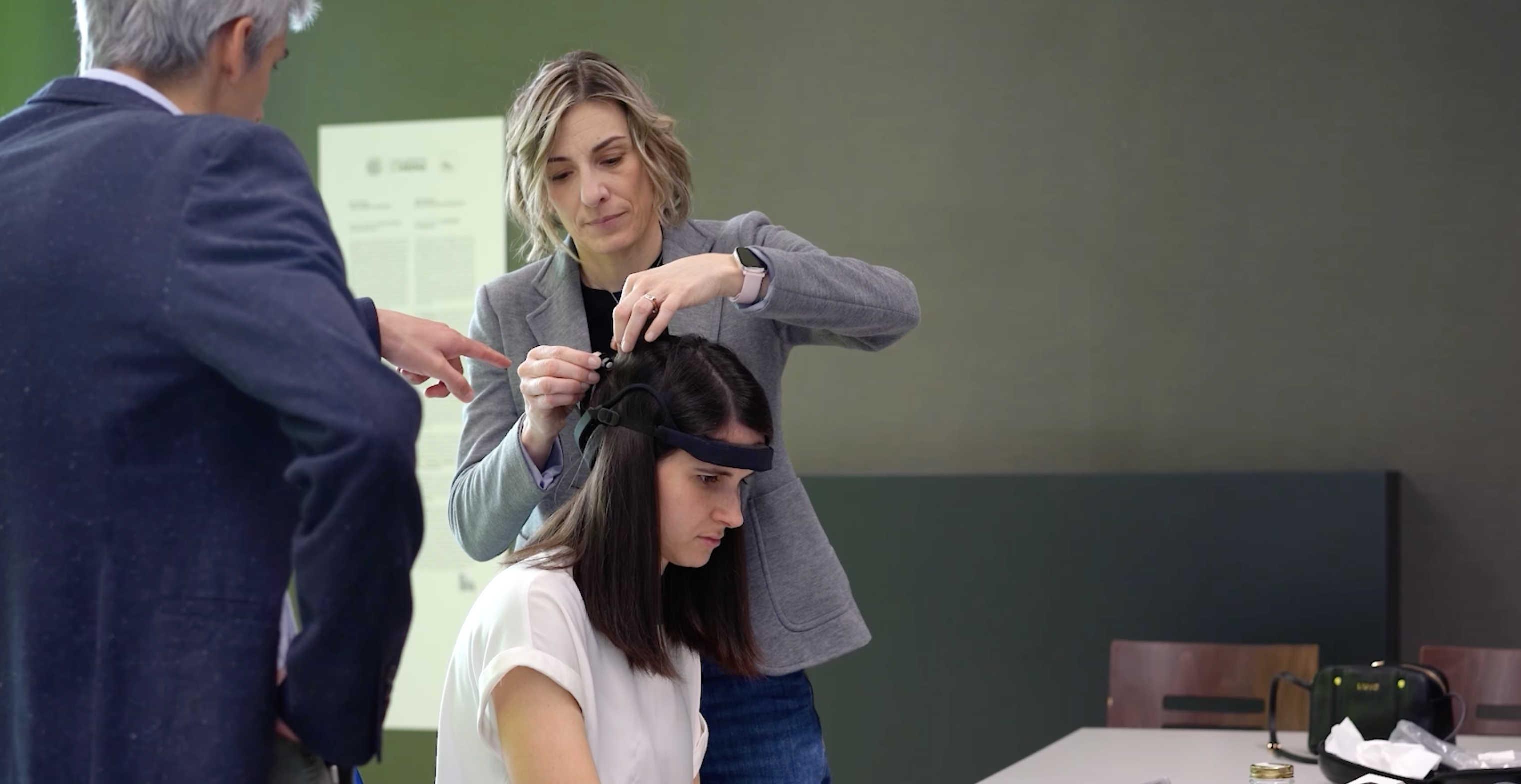
Prof. Silvia F. Storti, Dr. Nicola Valè and Dr. Ilaria Siviero have been interviewed by Observa for the Hereditary project
We are pleased to announce that Prof. Silvia F. Storti, Dr. Nicola Valè and Dr. Ilaria Siviero have been interviewed by Observa to discuss their latest work and contributions to the Hereditary project funded by the European Union. Watch the video to learn more about their insights and the ongoing research!

Dr. Nicola Valè has been selected for a research fellowship funded by the Italian Multiple Sclerosis Foundation (FISM)
We are proud to announce that Dr. Nicola Valè has been selected for a research fellowship funded by the Italian Multiple Sclerosis Foundation (FISM). This recognition reflects the quality and impact of his work in the field of multiple sclerosis. His research continues to contribute to both our laboratory’s activities and the wider scientific community. We warmly congratulate Dr. Valè and look forward to his future achievements.
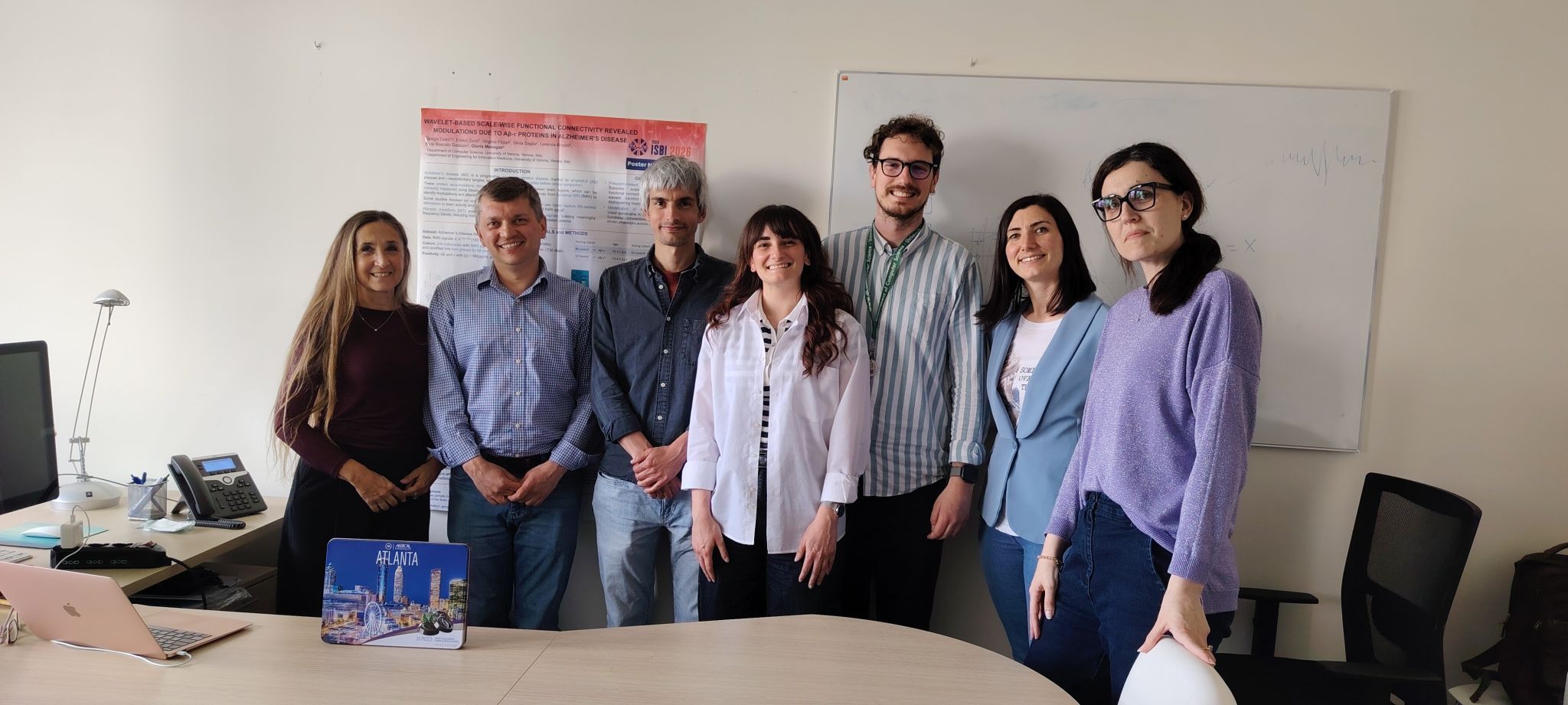
Prof. Sergey Plis visits our University and BrainNavLab
We were absolutely thrilled to recently host Prof. Sergey Plis, Full Professor of Computer Science at Georgia State University and a leading researcher at the TReNDS Center. During his visit, Prof. Plis delivered an insightful course for our PhD students titled “Fixed points, feedback, and adaptive computation”. It was a great pleasure to welcome him to our research group and have the opportunity to engage in stimulating discussions about his work. We deeply appreciate the time and expertise he shared with our students.
Contribution to OHBM 2026
We will contribute to OHBM 2026 with three works: 1) “Latent multivariate patterns link tau pathology to intrinsic brain activity in Alzheimer’s disease”; 2) “EEG-Based Connectome Analysis and Machine Learning Predict Surgical Outcome in Pediatric Epilepsy”; and 3) “EEG Microstates Pipeline for Source-Level Connectivity and Classification in Multiple Sclerosis”. Congratulations to Silvia Saglia and Edoardo Paolini and all the colleagues! Looking forward to the discussion!

International Day of Women and Girls in Science
Today BrainNavLab celebrates the International Day of Women and Girls in Science. Dr. Ilaria Siviero and Silvia Saglia participated in the promotional video by the University of Verona. We are proud to be a highly diverse and balanced group that values our scientists without any kind of discrimination.

Gloria Menegaz appointed Chair of the ISBI Steering Committee
We are proud to announce that our head, Prof. Gloria Menegaz, has been appointed Chair of the Steering Committee for the International Symposium on Biomedical Imaging (ISBI). ISBI is one of the leading international forums in biomedical imaging and related signal processing technologies, and this appointment recognizes her contributions to the field. Congratulations to Gloria on this well-deserved recognition!
Gloria Menegaz appointed to IEEE Signal Processing Society Technical Directions Board (2025)
We are proud to announce that Gloria Menegaz, Full Professor at the University of Verona and Group Leader at BraiNavLab, has been appointed to the Technical Directions Board of the IEEE Signal Processing Society (SPS) for 2025. Congratulations to Gloria on this well-deserved recognition!
Gloria Menegaz appointed Chair of the IEEE Bio Imaging and Signal Processing Technical Committee
Glad to announce that our head, Prof. Gloria Menegaz, has become Chair of the IEEE Bio Imaging and Signal Processing Technical Committee! Wishing you all the best in this new role.
New Publication on IEEE Transactions on Artificial Intelligence
We are happy to announce that our paper “How Can Artificial Intelligence and Brain Connectivity Inform Outcome Prediction in Drug-Resistant Epilepsy?” has been published on IEEE Transactions on Artificial Intelligence. If you’re curious about how brain connectivity and AI can make epilepsy care more personalized, this scoping review summarizes 41 studies using structural/functional/effective connectomes to predict drug resistance, localize the epileptogenic zone, and forecast postsurgical and VNS outcomes. Overall, better results are consistently linked to resecting highly connected/aberrant network hubs overlapping the EZ, and AI models often improve prediction beyond traditional biomarkers—while highlighting current limits in sample size, heterogeneity, and explainability.
Contribution to ICASSP 2026
We will contribute to ICASSP 2026 with “TRAIN2EXPLAIN: TRAINING OPTIMIZATION FOR EXPLANATION IMPROVEMENT”. Congratulations to Cristian Morasso et al. and looking forward to the discussion!

Contribution to ISBI 2026
We will contribute to ISBI 2026 with “Wavelet-Based Scale-Wise Functional Connectivity Revealed Modulations Due to Aβ-Tau Proteins in Alzheimer’s Disease”. Congratulations to Giorgio Dolci et al. and looking forward to the discussion!
New Publication on IEEE Transactions on Neural Systems and Rehabilitation Engineering
We are happy to announce that our paper “Artificial intelligence and wearable technologies for upper limb neurorehabilitation” has been published on IEEE Transactions on Neural Systems and Rehabilitation Engineering. If you’re curious about how wearable EEG/EMG neurorehabilitation systems are evolving, this paper reviews 51 studies and maps the field across biosignals, wearable setups, AI methods, and clinical applications. It also highlights key open challenges (accuracy, robustness, validation) and discusses how explainable AI and generative AI could improve interpretability and personalization in future upper-limb rehabilitation.
New Publication on IEEE Signal Processing Magazine
We are happy to announce that our paper “The Marriage of Neurotechnologies and Artificial Intelligence: Ethical, regulatory, and technological aspects” has been published on IEEE Signal Processing Magazine. If you’re curious about the ethical and legal risks emerging at the intersection of neurotechnology and AI, this paper provides a multidisciplinary overview of key issues—trustworthiness, fairness, awareness, security, and privacy—framed through a philosophical-ethics lens. It then connects these principles to today’s technological trajectory and the regulatory measures already in place (and still needed) to protect human integrity, identity, and autonomy.
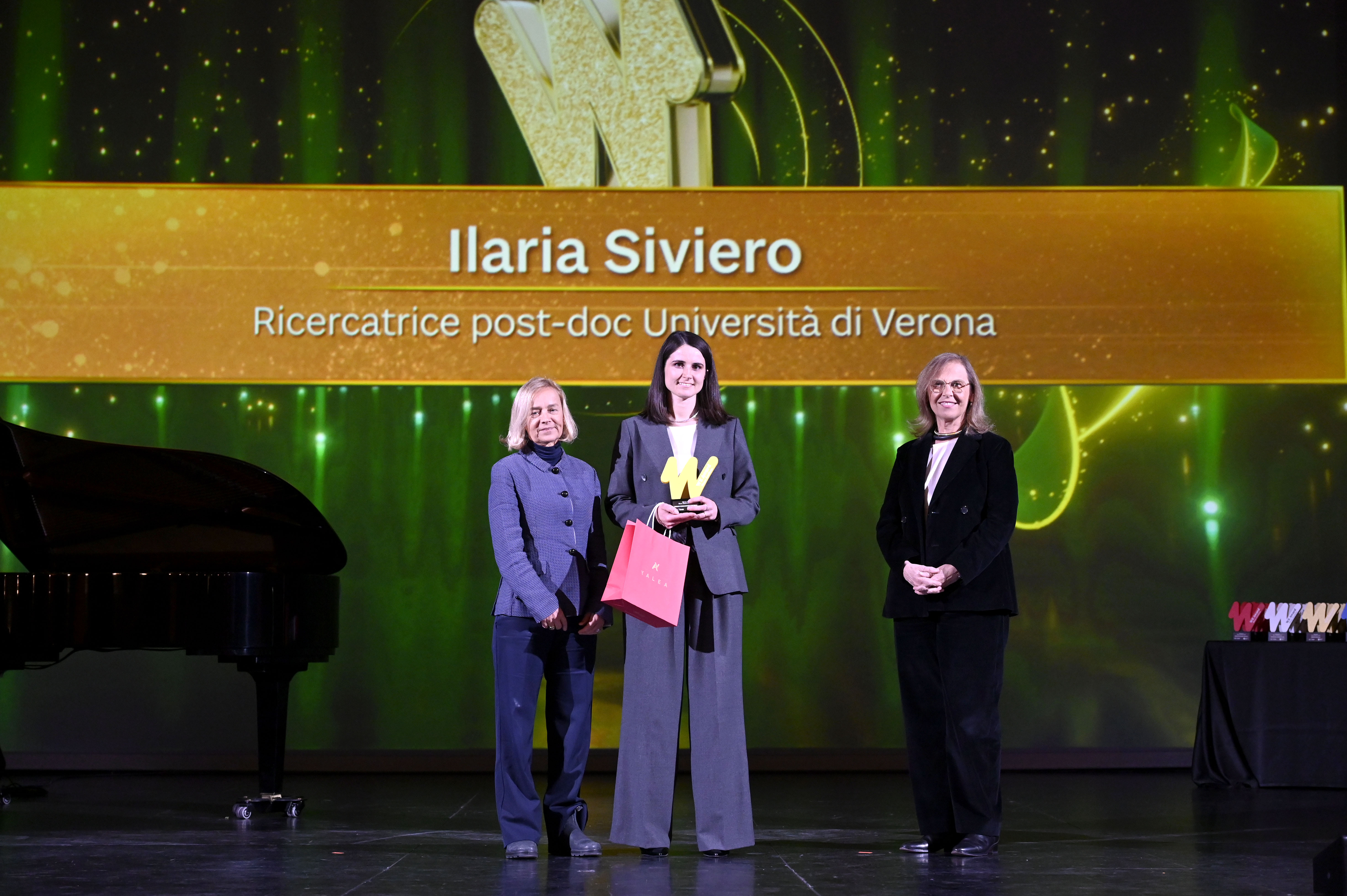
Dr. Ilaria Siviero has been awarded the prestigious WE Award – Women Excellence 2025
Dr. Ilaria Siviero, a postdoc researcher at the University of Verona, has been awarded the prestigious WE Award – Women Excellence 2025 in the Training and Research category. The awards ceremony took place in Milan as part of the Gala “Women at the Top 2025”, an event organized by Il Sole 24 Ore in collaboration with the Financial Times and the Sky TG24 media partnership. On that occasion, the 2025 Women Excellence Awards were awarded, recognitions reserved for women who, with talent, vision, and commitment, contribute concretely to innovation and the social, economic, and cultural progress of the country.
Dr. Nicola Valè has been awarded by the Italian Association of Physiotherapists
BraiNavLab postdoctoral researcher Nicola Valè received an award in the “Digital Technologies” session at the AIFI conference “Verso l’Appropriatezza Terapeutica: Moving between Clinical Practice and Evidence”. The recognition highlights our work on motor–cognitive interaction in multiple sclerosis, presented through a wearable EEG–IMU framework that enables the simultaneous recording of brain activity and movement during dynamic task like walking, supported by AI-based processing for automated trial segmentation and analysis.

New Publication on Wiley - Human Brain Mapping
We are happy to announce that our paper “Brain Connectivity Gradients Alterations in Discordant Cerebrospinal Fluid Profile for Alzheimer’s Disease Biomarkers” has been published on Human Brain Mapping by Wiley. If you’re curious about why some people show tau-positive but amyloid-negative CSF profiles, this study tests whether brain connectivity can separate discordant A−T+ individuals from concordant A+T+ cases in ADNI3. Using functional/structural connectivity gradients, the authors find that functional (but not structural) connectivity—especially along a temporo-occipital/posterior axis—distinguishes A−T+ from A+T+ with good accuracy, suggesting tau elevation without amyloid may reflect a distinct functional trajectory with different links to cognition compared to the classic DMN-related pattern seen in A+T+.
New Publication on Elsevier - NeuroImage
We are happy to announce that our paper “Linking dynamic connectivity states to cognitive decline and anatomical changes in Alzheimer’s disease” has been published on NeuroImage by Elsevier. If you’re curious about early network signatures of Alzheimer’s disease, this work introduces an unsupervised model that embeds Hidden Markov Model dynamics in a CNN to extract recurring dynamic functional connectivity states from resting-state fMRI across controls, MCI, and AD. The study shows that how long the brain “dwells” in each state changes systematically with disease severity—supporting a two-stage trajectory of network disruption and providing a potential tool for early diagnosis and longitudinal monitoring.
New Publication on IOP - Journal of Neural Engineering
We are happy to announce that our paper “An interpretable generative multimodal neuroimaging-genomics framework for decoding Alzheimer’s disease” has been published on Journal of Neural Engineering by IOP. If you’re curious about combining multimodal MRI and genetics for Alzheimer’s prediction, this work proposes an interpretable deep-learning framework that can impute missing modalities (via cycle-GANs in latent space) and then explain which inputs drive decisions. It achieves competitive performance for both AD vs controls and MCI conversion, while highlighting disease-relevant gray matter changes, resting-state network disruptions, and genetic signals linked to processes such as endocytosis, amyloid-beta, and cholesterol pathways.
New Publication on Elsevier - Neurobiology of Disease
We are happy to announce that our paper “Functional dynamic network connectivity differentiates biological patterns in the Alzheimer’s disease continuum” has been published on Neurobiology of Disease by Elsevier. If you’re curious about how Alzheimer’s pathology maps onto brain network dynamics, this study combines molecular imaging with resting-state fMRI to show that data-driven patient subtypes align with distinct abnormalities in dynamic functional connectivity. In particular, connectivity patterns involving the default mode network and occipito-temporal regions help differentiate typical vs atypical biological profiles—suggesting dynamic connectivity markers can flag AD-like symptoms arising from different underlying pathologies.